
Children thrive academically when their family and friends show interest in their school and learning. Even small gestures such as asking about their day, reviewing homework, or celebrating achievements, demonstrate that you care about their education. Research shows that children who feel supported at home are often more confident and successful learners at school. No matter your lifestyle or family situation, it’s never too early, or too late, to help a child develop a positive attitude toward learning.
English Reading
At Whitehill, we place great importance on developing children’s reading skills, as reading underpins learning across all subjects. High-quality texts form the foundation of our English curriculum, with increasing complexity as children progress. We also value non-fiction and ensure access to a broad range of texts. Our book corners are designed to make reading both enjoyable and accessible for all.
In the Early Years and Key Stage 1, we use Little Wandle Phonics to systematically develop phonemic awareness and early reading skills, building knowledge step by step so children gain the confidence to approach more challenging texts.
Fostering a love of reading is central to children’s academic and personal development. We encourage reading for pleasure and provide opportunities for children to explore texts that challenge and inspire them. Our two well-stocked libraries offer a wide range of materials to enjoy at school and at home. We further promote reading through initiatives such as author polls, reading competitions, and nationwide events including World Book Day, Roald Dahl Day, and the BBC 500 Words competition.
We also use Renaissance’s Accelerated Reader to support independent reading. Children are assessed to identify their reading level and guided to books that balance enjoyment and challenge, helping them select texts that are right for them both at school and at home.
For more resources and advice, including games to support English reading, please visit our curriculum page.
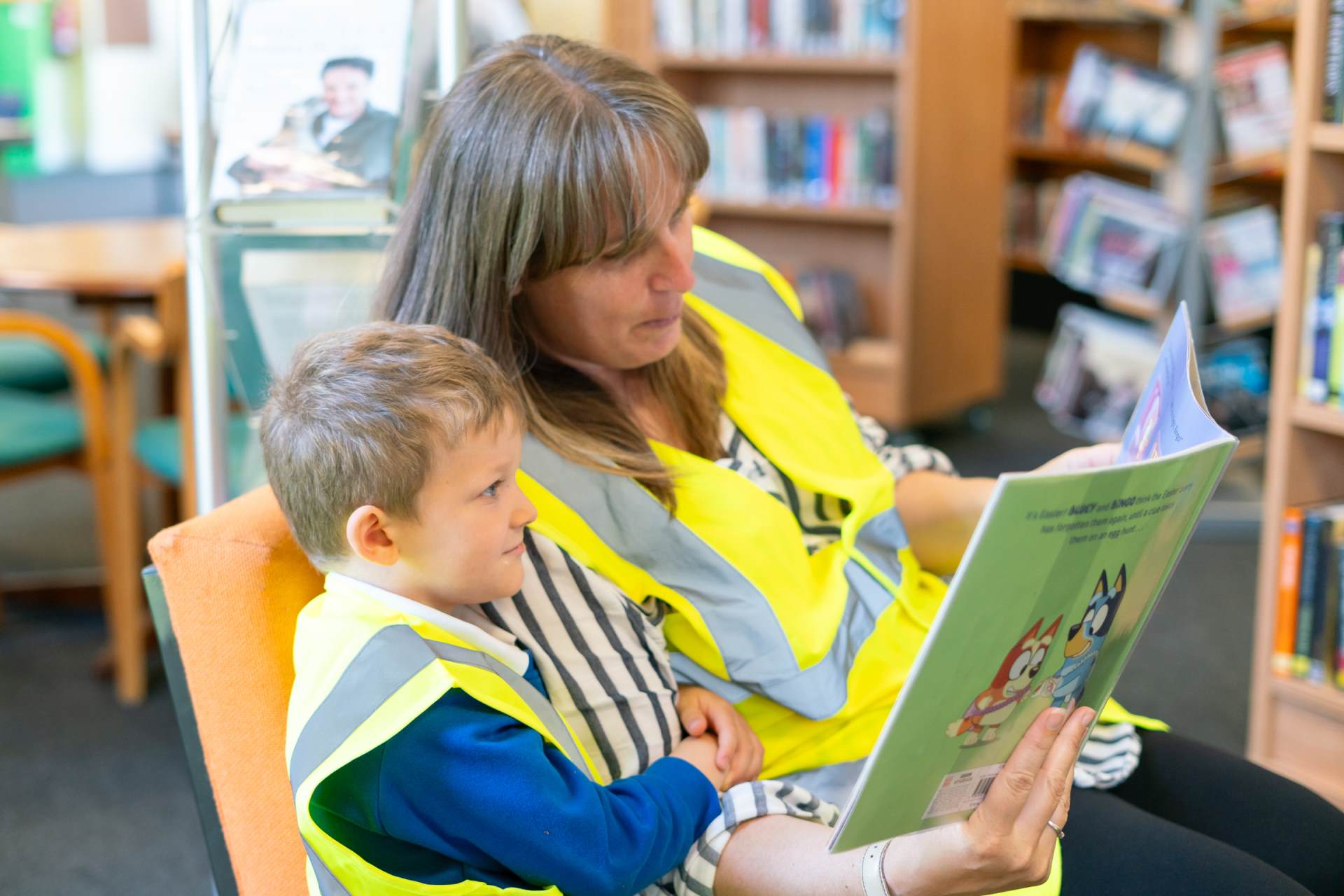
Supporting Your Child at Home with Reading
Supporting your child with their reading at home is invaluable. It should be an enjoyable experience for everyone involved, so be sure to give your child plenty of praise and encouragement.
The following guidelines can help develop your child’s reading skills:
- Find a quiet, comfortable place to sit together (with the television switched off).
-
Look at the cover and discuss the picture. What does your child think the story will be about?
-
Read the title to your child, pointing to each word with your finger.
-
Read the story to your child.
-
Re-read the story (either immediately or later) while discussing the pictures and pointing to each word so your child becomes aware of the voice-print match (spoken word = written word).
- Ask your child questions about the story.
- Ask your child to read the story to you. It doesn’t matter if they guess sentences, use pictures as clues, or have memorized parts of the text.
- Pick out a single word and ask your child to find it elsewhere in the book.
- Count how many words are on a page.
- Ask your child to identify initial sounds and, if able, blend them to read words.
- Write words on individual pieces of paper and ask your child to match them to words in the book.
- Play hide and seek: hide words around the room and ask your child to find and read them.
You do not need to follow every step each time – reading should always be fun!
English Writing
Provide your child with opportunities to use pencils and pens. Encourage your child to ‘mark make’ and develop good pencil control. Encourage your child to use writing in their play – ‘emergent writing’ (squiggles, lines, shapes and possibly some letters) for example, if they are playing shops get them to write a shopping list.
At meal times ask them to take food orders from the family. If your child is keen to learn how to write their name please help us by teaching them that the first letter of their name is a capital letter and the rest are lower case letters. Please use the letter formations below to help your child learn how to write the lower case letters correctly.
For more resources and advice, including games to support English writing, please visit our curriculum page.
Mathematics – Key Instant Recall Facts (KIRFs)
KIRFs are designed to develop the mental fluency skills that underpin much of the mathematics curriculum. These key facts are particularly helpful when calculating; whether adding, subtracting, multiplying, or dividing.
Each year group focuses on up to six sets of key facts across the year, in line with the National Curriculum and age-related expectations. These will be taught and revisited regularly in school; however, frequent practice at home, little and often, greatly supports children in learning and confidently recalling them.
Instant recall of number facts significantly improves mental agility in mathematics. When children progress to written calculations and more abstract concepts, secure knowledge of these facts becomes essential. Short, regular practice helps children store these facts in their long-term memory and apply them with ease.
For more resources and advice, including games to support Mathematics, please visit our curriculum page.