
Music Subject Leader: Mrs J Poulson
Music education improves, develops and broadens the range of creative skills. This is incorporated into daily routines and inspires self-expression through a variety of mediums.
Intent
At Whitehill Primary School, our music curriculum is designed to inspire creativity, self-expression, and a lifelong love of music. We aim to support every child on their musical journey, providing opportunities to connect with others, explore different musical experiences, and develop their individual talents as singers, performers, and composers. Through listening, performing, and composing across a variety of styles, children become confident, reflective, and expressive musicians.
We recognise that music is a universal language that embodies one of the highest forms of creativity (National Curriculum, 2014). Our curriculum seeks to engage and inspire pupils, nurturing self-confidence, creativity, and a sense of achievement. As children progress, they develop a critical engagement with music, enabling them to compose, perform, and listen with discrimination to music from a broad range of genres, historical periods, and cultural traditions.
Through our music curriculum, pupils will:
-
Sing and use their voices individually and in groups with confidence and expression.
-
Create and compose music independently and collaboratively, using technology where appropriate.
-
Learn to play a range of instruments and participate in performances.
-
Understand how music is created, produced, and communicated.
-
Listen to, review, and evaluate the work of composers and musicians from different periods and cultures.
-
Enjoy and appreciate a variety of musical styles, including Classical, Jazz, Hip Hop, Pop, and Rock.
-
Use and understand musical language, incorporating musical features into their own work.
-
Make informed judgements about the quality of music and develop critical listening skills.
Our intent is to cultivate musically confident, curious, and creative learners who can express themselves, collaborate with others, and carry their passion for music beyond the classroom.

Implementation
Our Music curriculum is delivered through a structured and progressive approach, underpinned by the Charanga Musical School scheme. From Year 1 to Year 6, children receive regular music lessons that ensure exposure to a wide range of genres, musical styles, and creative opportunities.
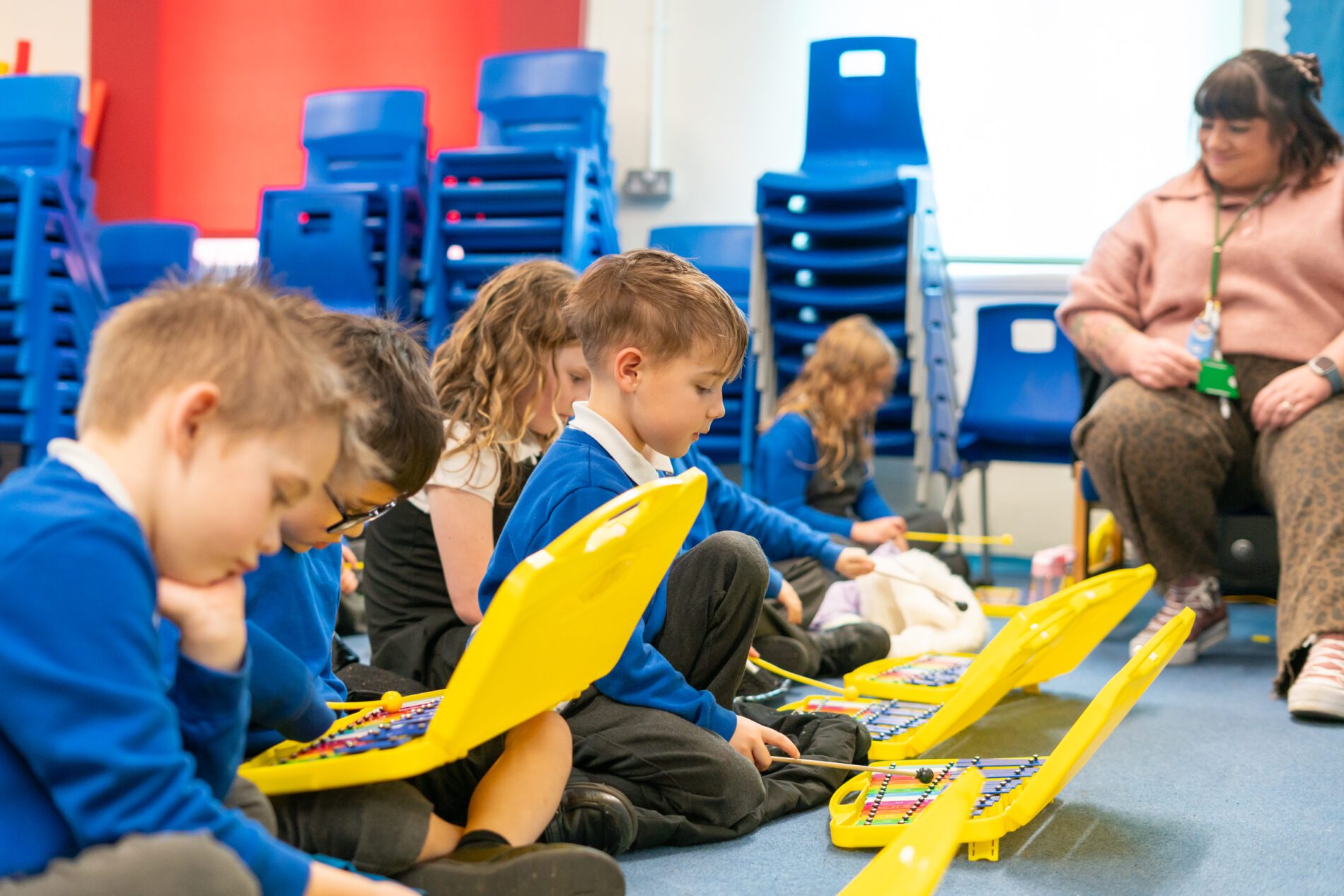
We combine whole‑class teaching, practical instrument sessions, ensemble work and performance experiences. All children in Year 1 begin with whole‑class ensemble teaching, learning ocarina or percussion, followed in Year 3 by recorder lessons, and in Year 5 by ukulele tuition. These instrument lessons incorporate musical notation, singing, and playing, giving children a solid foundation in musicianship.
Beyond instrument tuition, children have opportunities to compose, perform, improvise and use body‑percussion, vocal sounds and technology, making music accessible even where instruments are not used. Music lessons are enriched by regular performances, in class, assemblies, school events and community settings, and by themed events such as a June Music Week or music‑extravaganza assemblies that celebrate children’s musical learning.
Through integration with other curriculum areas, music learning is embedded and brought to life across different contexts, allowing children to apply their musical understanding in social, historical, cultural, and technological settings. This gives pupils the freedom to shape their own musical journey, whether as listeners, creators or performers, and supports them to grow in confidence, creativity and musical skill.
Impact
At Whitehill Primary, the impact of our music curriculum is evident in the confidence, creativity, and musical skills demonstrated by our pupils. Music assessment is ongoing and used to inform teachers’ planning, lesson activities, and differentiation, ensuring that learning is tailored to meet the needs of all children. Summative assessments are completed at the end of terms one, three, and five to provide leaders with a clear picture of progress, highlighting areas where skills have been embedded and where further development is required.
The quality of music teaching and learning is monitored throughout all year groups using a variety of strategies, including lesson observations, staff questionnaires, and pupil interviews. This monitoring ensures that children have regular opportunities to develop their musicianship, including performing, composing, and listening critically.
Through these processes, pupils demonstrate increasing confidence and competence in their musical abilities. They are able to engage in ensemble and solo performance, compose original music, and respond thoughtfully to a range of musical styles. Music assessment and monitoring allow teachers and leaders to identify progress, celebrate achievement, and ensure that every child continues to grow as a confident, expressive, and reflective musician.
Music in Each Stage
Children listen attentively to sounds, explore instruments and vocal sounds, create simple melodies, sing familiar songs, and respond to music through movement and expression. They begin to understand pitch, pulse, and rhythm.
Pupils sing in groups and individually, play tuned and untuned instruments, improvise using simple notes, and begin composing short melodies. They explore rhythm, pulse, and dynamics and start to understand musical notation.
Lower KS2 (Year 3 & Year 4)
Children continue developing singing techniques, learn new instruments (recorder), perform in groups, and compose melodies using up to five notes. They deepen understanding of pulse, rhythm, pitch, tempo, dynamics, texture, and structure, and are introduced to musical notation for their compositions.
Upper KS2 (Year 5 & Year 6)
Pupils develop proficiency in their chosen instruments (ukulele), perform confidently in ensembles, compose and record their own music using more complex techniques, and use musical notation effectively. They analyse and evaluate music, understand diverse musical styles, and lead group performances, applying all elements of music creatively and collaboratively.
Music Progression
Inclusion & Equal Opportunities
Our music curriculum is inclusive and accessible for all with support in place for our SEND and EAL children. All children will have the opportunity to sing, play a musical instrument, understand notation and enjoy a variety of different musical genres. Our more able children will be stretched and challenged within lessons. All children will be given the opportunity to take part in local and wider field concerts and given support and guidance to explore individual music lessons in school and other musical experiences beyond school.
Enrichment & Beyond the Classroom
We encourage parents/carers to support our performances and take an interest in the children’s music learning, musical trips as well as helping the children to practice at home. We collaborate with our local community visiting and performing in person and on line to care homes and local churches. To keep abreast of the music curriculum and up to date with our music knowledge skills, we attend Gravesham Network meetings and also collaborate with our partner school’s music department. We invite experienced musicians, choirs, actors and dancers to carry out workshops enabling our children to develop a holistic approach to their learning.