
Mathematics Subject Leader: Mr H Joyce – joyceh@whitehillprimary.com
Intent
At Whitehill Primary School, our Maths curriculum is designed to ensure that all children develop a deep, flexible and secure understanding of mathematics, enabling them to master the content appropriate to their year group and leave our school “secondary ready”. We follow the White Rose Maths scheme, using its carefully sequenced small-steps approach and adapting resources where needed to provide a consistent, comprehensive journey through the mathematics curriculum.
Teaching is underpinned by the Concrete, Pictorial and Abstract (CPA) approach, which enables pupils to recognise and make sense of the maths in the world around them. Skilled teachers use concrete and visual representations to bridge gaps in understanding, supporting pupils who need additional time or visualisation as well as those ready to be challenged to achieve Greater Depth.
We place a strong emphasis on developing automaticity in key facts and procedures, reducing cognitive load so that pupils can apply their knowledge efficiently and confidently. Our mastery approach builds on this solid foundation, promoting a deeper level of understanding that can be transferred to a wide range of contexts.
Reasoning and problem solving are embedded throughout the curriculum. Children are encouraged to articulate and justify their thinking using precise mathematical vocabulary, explore relationships and patterns, and consider the impact of changing variables—developing the curiosity, confidence and clarity that characterise true mathematicians.

Implementation
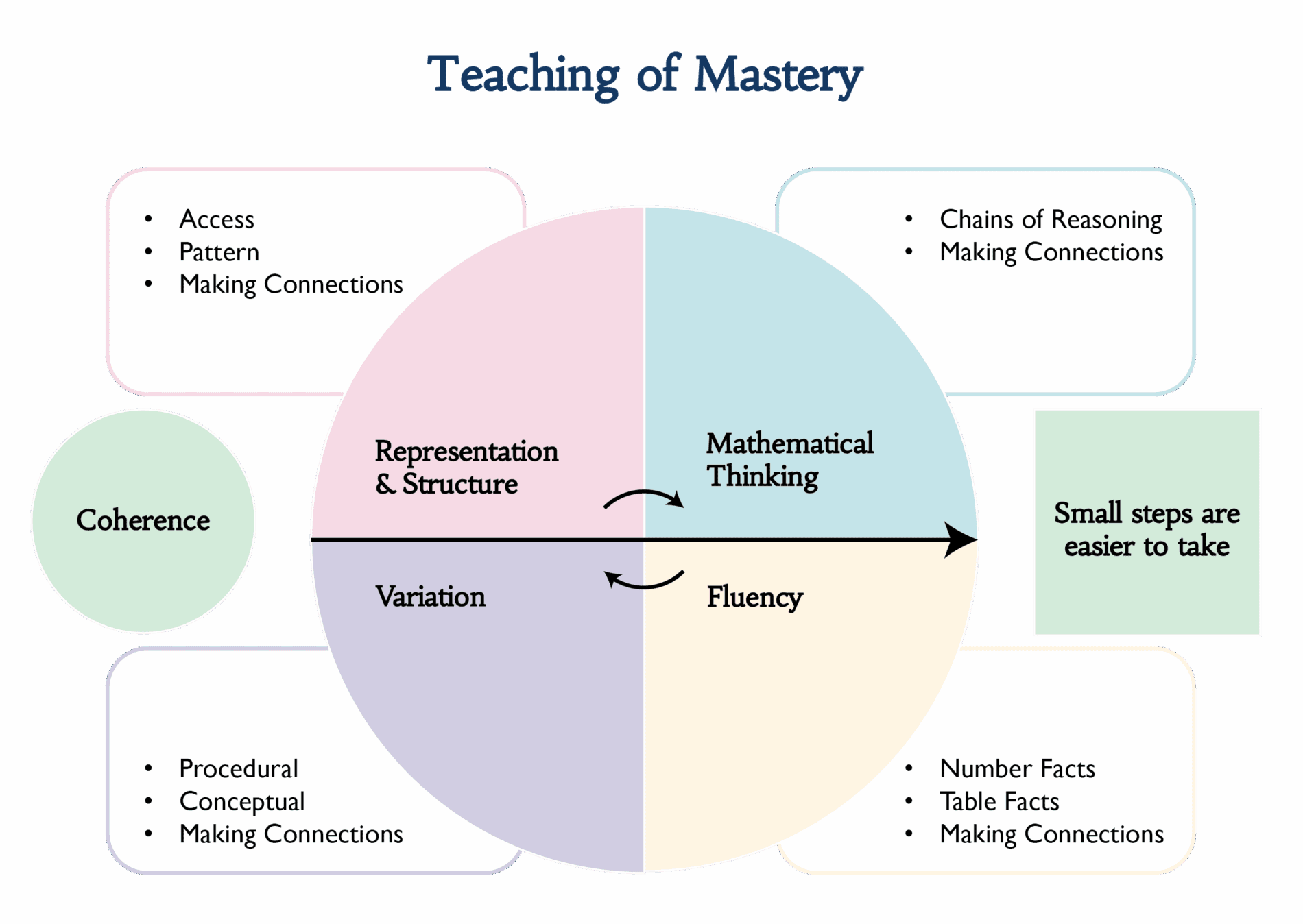
At Whitehill Primary School, mathematics is taught using a mastery approach designed to ensure secure, deep and connected understanding for all learners. Our practice is underpinned by the Concrete, Pictorial, Abstract (CPA) approach and the five core principles of teaching for mastery.
Fluency
We develop pupils’ quick and efficient recall of key facts and procedures, enabling them to move flexibly between different contexts and mathematical representations. Building automaticity reduces cognitive load, allowing children to devote attention to higher-order thinking and reasoning.
Representation and Structure
Teachers expose the underlying mathematical structures that underpin number and calculation. A range of carefully selected representations is used to help pupils ‘see’ patterns, laws and relationships. Representations are designed to illuminate the structure so that, over time, pupils can work confidently at an abstract level without relying on them.
Variation
Concepts are presented in multiple ways to draw attention to key features and deepen understanding. Teachers carefully design the sequence of examples, activities and tasks, deliberately keeping some elements the same while varying others to highlight connections and mathematical relationships.
Mathematical Thinking
Pupils are encouraged to think deeply, reason mathematically and articulate their ideas. Through discussion, pattern-spotting, making connections and exploring relationships, they develop the habits of mind that define a mathematician.
Coherence
Learning is broken down into small, connected steps that gradually unfold a concept. This ensures accessibility for all pupils while building towards generalisation and the ability to apply learning across a range of contexts.
Concrete-Pictorial-Abstract (CPA)
Teachers use CPA strategically to support conceptual understanding.
-
Concrete: Pupils manipulate physical objects to explore mathematical ideas.
-
Pictorial: Diagrams, drawings and visual models help pupils bridge from the concrete to the abstract.
-
Abstract: Pupils use symbols and formal methods to represent their thinking independently.
CPA is not linear or prescriptive; teachers apply professional judgement to select the representations that best expose the structure being taught.
Impact
The impact of our mathematics curriculum is monitored rigorously to ensure that all pupils are making strong progress and are working towards mastery.
Assessment
-
Teachers use Target Tracker, uploading data three times a year to identify strengths and areas for development.
-
Standardised assessments are used termly to provide further evidence of progress and attainment.
-
Times Tables Rock Stars Soundchecks support assessment of fluency in multiplication facts.
Teachers combine assessment data with their professional knowledge of each pupil to form accurate judgements and plan next steps.
Moderation
Regular in-house moderation allows staff to discuss evidence, challenge interpretations and ensure consistency across the school.
Monitoring
The Maths Lead and senior leadership team closely monitor the quality of mathematics teaching through:
-
Book looks
-
Lesson observations
-
Learning walks
-
Pupil voice activities
This enables the school to evaluate the effectiveness of the curriculum, identify strengths, and plan for continuous improvement.
Mathematics in Each Stage
All maths learning in EYFS is based on the document “Development Matters”. In Nursey, a mixture of formal teaching and informal learning opportunities that follow the interest of the children are used. In Year R, teachers follow the White Rose schemes of learning – principally securing the representations of numbers up to 10 and recognising number to 20. Children are encouraged to spot patterns and identify differences through variation. EYFS children begin their fluency journey by noticing and recalling numbers up to 20. EYFS practise is predicated on exploration and discovery with songs and repetition to secure foundational knowledge.
The principal focus of mathematics teaching in key stage 1 is to ensure pupils develop confidence and mental fluency. The essential idea behind the mastery approach is that all children have a deep understanding so that future learning continues to build on solid foundations. If the subject is represented using concrete materials, pictorial representations and abstract symbols, it will allow children to visualise maths in varied ways, see connections and to independently explore and investigate a topic. Practical activities and resources offer the children a deeper mathematical understanding of more complex concepts. Providing children with visual representations also offers a scaffold when developing a more robust understanding of maths.
Throughout Key Stage 1, it is important that children gain a secure knowledge of number and place value and become confident when using the four operations in both formal methods as well as problem solving where often the approach is not immediately evident. Alongside number work, pupils begin to identify fractions using shapes, objects and quantities and make connections to equal sharing and grouping. Pupils are taught to count to ten in fractions, recognise equivalent fractions and develop their understanding of fractions on a number line. At this stage, pupils will also develop their ability to recognise, describe, draw, compare and sort different shapes. Pupils have the opportunity to use a range of measures to describe and compare different quantities such as length, mass, capacity/volume, time and money and are expected to use related vocabulary for all topics. Other subjects may have strong links to some maths topics allowing cross-curricular teaching. For example, shape through art or computing, measures through science or coordinates in geography. This is to ensure we continually maximise learning opportunities for all pupils across an entire curriculum.
Lower Key Stage 2 (Years 3-4):
The principal focus of mathematics teaching in lower Key Stage 2 is to ensure that pupils become increasingly fluent with whole numbers and the four operations, including number facts and the concept of place value. This should ensure that pupils develop efficient written and mental methods and perform calculations accurately with increasingly large whole numbers. At this stage, pupils should develop their ability to solve a range of problems, including with simple fractions and decimal place value. Teaching should also ensure that pupils draw with increasing accuracy and develop mathematical reasoning so they can analyse shapes and their properties, and confidently describe the relationships between them. It should ensure that they can use measuring instruments with accuracy and make connections between measure and number. By the end of Year 4, pupils should have memorised their multiplication tables up to and including the 12 multiplication table and show precision and fluency in their work.
Upper Key Stage 2 (Years 5-6):
The principal focus of mathematics teaching in upper Key Stage 2 is to ensure that pupils extend their understanding of the number system and place value to include larger integers. This should develop the connections that pupils make between multiplication and division with fractions, decimals, percentages and ratio. At this stage, pupils should develop their ability to solve a wider range of problems, including increasingly complex properties of numbers and arithmetic, and problems demanding efficient written and mental methods of calculation. With this foundation in arithmetic, pupils are introduced to the language of algebra as a means for solving a variety of problems. Teaching in geometry and measures should consolidate and extend knowledge developed in number. Teaching should also ensure that pupils classify shapes with increasingly complex geometric properties and that they learn the vocabulary they need to describe them. By the end of Year 6, pupils should be fluent in written methods for all four operations, including long multiplication and division, and in working with fractions, decimals and percentages.
Mathematics Progression
Inclusion & Equal Opportunities
Teaching maths for mastery is different because it offers all pupils access to the full maths curriculum. This inclusive approach, and its emphasis on promoting multiple methods of solving a problem, builds self-confidence and resilience in pupils. Though the whole class goes through the same content at the same pace, there is still plenty of opportunity for differentiation. Taking a mastery approach, differentiation occurs in the support and intervention provided to different pupils, not in the topics taught, particularly at earlier stages. Where possible there is no differentiation in content taught, but the questioning and scaffolding individual pupils receive in class as they work through problems will differ, with higher attaining children, or those pupils who grasp concepts quickly, challenged through more demanding problems which deepen their knowledge of the same content. Those children who are not sufficiently fluent are provided additional support to consolidate their understanding before moving on. Pupils’ difficulties and misconceptions are identified through immediate formative assessment and addressed with intervention – commonly through individual or small group support later the same day where possible. Where children make less than expected progress efforts are made to ensure relevant support is put in place to help support the child. Concepts will be revisited throughout the year during challenge times or intervention times to help with long term understanding. Where children are operating at a pre-key stage level, then they should have a personalised curriculum in place and tasks should be differentiated accordingly.
Enrichment & Beyond the Curriculum
Parental involvement is an essential aspect to Maths, especially for the development of fluency in the recall of number facts. It is crucial that the school and parents work together in order to support the pupils at Whitehill. In order to achieve this, there is an expectation that the school will set pupils number facts practice at home. There is also the expectation that parents will practice these with their children at home and that the school will provide information to support parents in doing this. Furthermore, we would like to regularly invite parents into school to for maths events that develop cultural capital. This will allow parents to come into school and to share positive enriching experiences with their children that centre around maths. We will also run workshops with parents to show ways of supporting and developing maths at home.
Mathematics Extra Resources
Further Mathematics Help
Fun Mathematics Games