
Physical Education Subject Leader: Mr D Fasham – dfasham@whitehillprimary.com
By embedding a high-quality physical education curriculum, it helps to inspire our pupils to excel in competitive sports; providing opportunities for pupils to sustain their health and fitness.
Intent
At Whitehill Primary School, our PE curriculum aims to inspire all children to be active, confident and healthy. Through the Greenacre Sports Partnership scheme of work, pupils develop core physical skills that progress year-on-year and can be applied across a wide range of sports and activities. Children learn to work both independently and as part of a team while experiencing success, challenge and competition in a supportive environment.
We believe PE plays a vital role in developing the whole child. It promotes physical fitness and wellbeing, supports positive mental health, and helps pupils build important life skills such as teamwork, leadership, resilience and sportsmanship. Our curriculum encourages children to understand the value of physical activity, make healthy choices and enjoy being active both in and out of school.
Through a broad and balanced programme, we aim to ensure every child:
-
Develops confidence, competence and control in a range of physical skills
-
Understands how physical activity contributes to a healthy body and mind
-
Can manage risk and take responsibility for their own safety
-
Learns to communicate, collaborate and solve problems through movement
-
Experiences appropriate challenge and opportunities for competition
-
Enjoys PE and is encouraged to take part in lifelong physical activity

Implementation
At Whitehill, PE is taught progressively across all year groups, ensuring that children develop competence, confidence, and enjoyment in a wide range of physical activities. Lessons are planned using the school’s PE progression framework to support skill development from Nursery through to Year 6.
How PE is Delivered
-
Pupils engage in a variety of sports and physical activities, including games, gymnastics, dance, athletics, and ball skills (football, netball, hockey), with activities increasing in complexity as they progress through the school.
-
Lessons focus on developing fundamental movement skills, coordination, balance, agility, strength, and stamina, alongside fine and gross motor skills in the younger years.
-
Children are given opportunities to develop both individually and as part of a team, applying skills in group games and cooperative challenges.
-
Activities are inclusive and differentiated to support all abilities, ensuring that every child can make progress and experience success.
Supporting Physical and Personal Development
-
PE lessons contribute to children’s physical health, well-being, and confidence.
-
Pupils also learn important life skills such as collaboration, resilience, sportsmanship, and self-management through structured physical activities.
-
Through this approach, children are equipped with the skills, understanding, and confidence to lead active, healthy lifestyles both in and out of school.
Impact
Assessment in PE at Whitehill Primary School is continuous and purposeful. Teachers observe pupils throughout each lesson, giving guidance and support to ensure every child makes strong, sustained progress. Lessons are fully inclusive, with activities adapted to meet the needs and abilities of all pupils.
Progress is tracked using the Target Tracker system alongside the PE monitoring progress form created by the subject lead. Teachers record pupils’ development against key skills and learning statements, enabling both class teachers and the PE lead to:
-
Identify strengths and areas needing further support
-
Monitor progress across classes and year groups
-
Highlight pupils who may require additional intervention or challenge
This systematic approach ensures that all children are developing the physical skills, confidence and understanding needed to lead active, healthy lives.
Physical Education in Each Stage
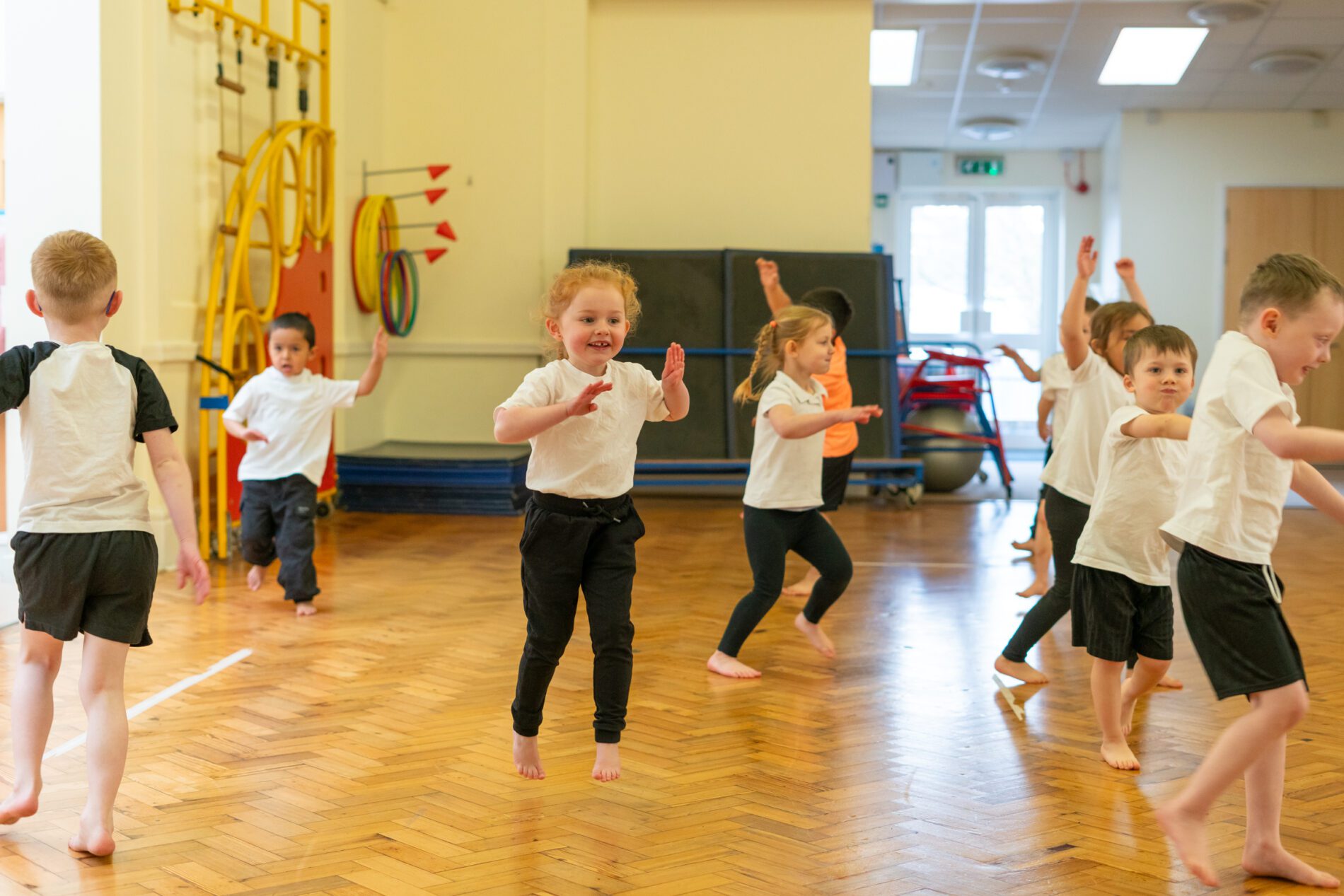
In Nursery and Reception, PE supports children to develop basic physical skills through BEAM, movement, play and guided activity. Children practise large-muscle movements, climbing, balancing, skipping, hopping, as well as developing coordination, control and spatial awareness. They begin building confidence in managing their bodies, using simple equipment, and taking part in group play. From early movement routines to rhythm and pattern in dance or play, the emphasis is on enjoyment, exploration and physical development for everyday tasks and early sport.
In Years 1 and 2, children build on their early movement skills by developing agility, balance and coordination more intentionally. They start mastering basic ball and object-control skills: throwing, catching, kicking or bouncing; they begin to apply these in simple games. PE sessions introduce them to teamwork, cooperation, basic rules, and simple game-based activities. This phase helps them consolidate fundamental movement skills and learn to enjoy being active, while building confidence, control and coordination.
Lower KS2 (Years 3 & 4)
In Years 3 and 4, pupils refine their basic skills and start combining them in more complex movements and activities. They practise and develop ball skills, coordination, rhythm, and accuracy, and begin to use these in more structured games and physical contexts. They are also exposed to a wider variety of sports and physical activities, building competence, confidence and a deeper understanding of movement. This phase aims to help children gain control over their bodies, improve agility and coordination, and enjoy a broader range of physical challenges as they grow.
Upper KS2 (Years 5 & 6)
In Years 5 and 6, children apply and consolidate a wide range of skills, from refined ball control and coordination to more advanced movement sequences, tactics and game-play. They begin to understand more complex aspects of sport, such as teamwork, strategy, passing/dribbling/shooting in team games, defending/attacking roles, and making decisions in competitive or cooperative situations. Pupils work on precision, control, stamina, and coordination across different sports and contexts, preparing them not just for school PE but for lifelong active participation.
Physical Education Progression
Inclusion & Equal Opportunities
At Whitehill Primary, we are committed to promoting equal opportunities irrespective of socioeconomic background, gender, disability and ethnicity in all areas of the curriculum. We believe that children should have equal access to and participation in a range of physical education activities. Teachers plan their lessons and make necessary adaptations to ensure appropriate challenge and accessibility for all learners. We are committed to ensuring that all children participate in PE and physical activity irrespective of any special educational need(s) or physical disability they may have. We believe that children should have equal access to and participation in a range of physical education activities in order to reach their own potential. Research has shown that children ALL participating in PE together proves better outcomes for ALL. The Greenacre schemes allows for differentiation for all abilities, giving the teachers ideas and support for less or more able students.
Enrichment & Beyond the Curriculum
Parents are encouraged to attend Sports day to celebrate and promote physical activity, as well as support groups to travel to sporting events as support. In terms of reporting on progress, annual reports are written about each child for parents/carers and PE is listed as a foundation subject in all reports.